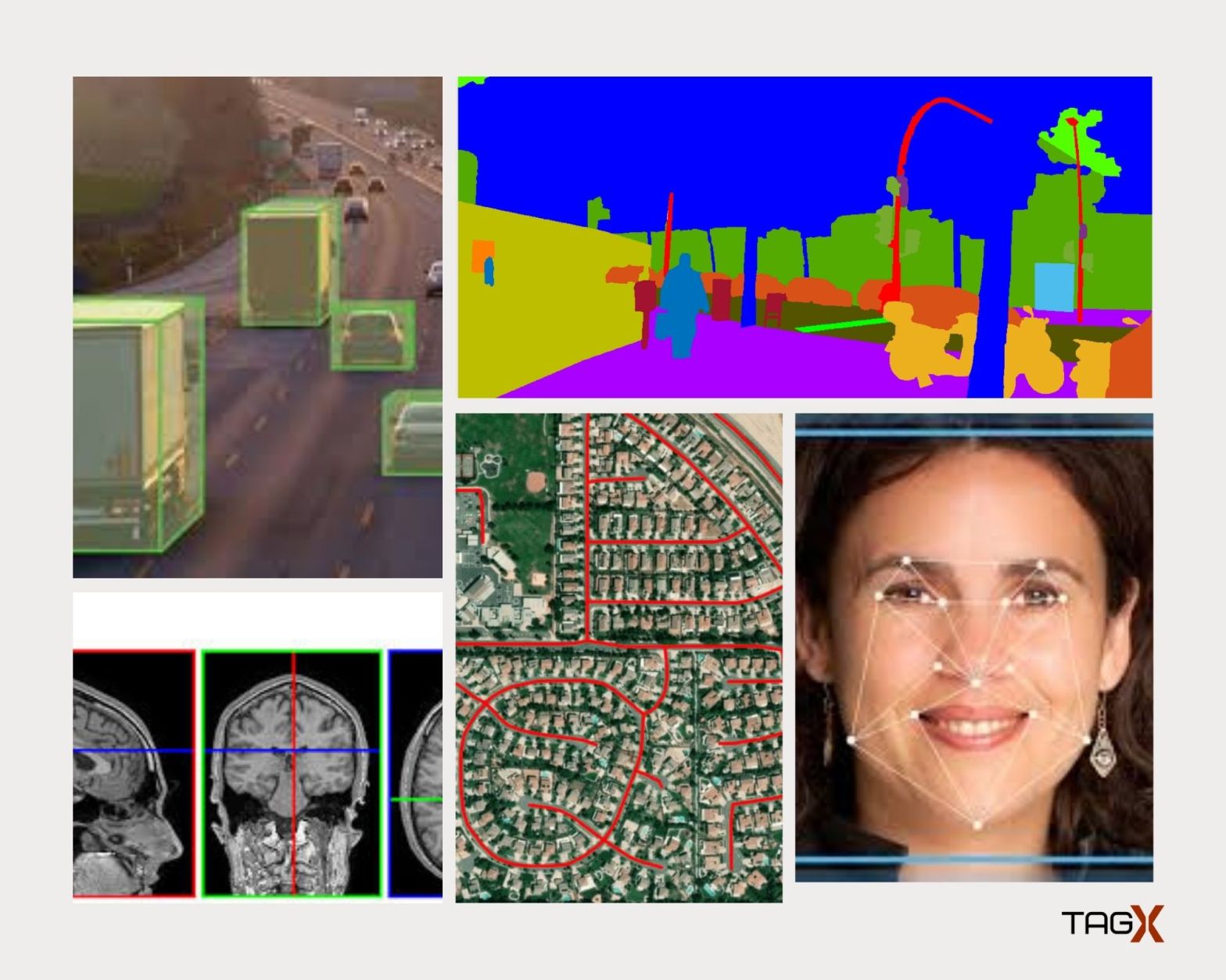
How to collect Data for Computer Vision?

Computer vision algorithms are no magic. They need data to work, and they can only be as good as the data you feed in. The development of Computer vision algorithms depends on large volumes of data, from which the learning process draws many entities, relationships, and clusters. To broaden and enrich the correlations made by the algorithm, it needs data from diverse sources, in diverse formats, about diverse business processes. 

Collecting and preparing the dataset is one of the most crucial parts while creating an ML/AI project.The technology applied behind any Machine learning  projects cannot work properly if the dataset is not well prepared and pre-processed.These are different sources to collect the right data, depending on the task. Given below we have shared four different ways in which you can acquire data for your model.

1. Get Open Datasets

Public datasets come from organizations and businesses that are open enough to share. These are easily accessible and available to use, typically online. Individuals, businesses, governments, and organizations created them. Some are free, and others require the purchase of a license to use the data. Open data is sometimes called public or open source but it generally cannot be altered in its published form. It is available in various formats (e.g., CSV, JSON, BigQuery). Explore Kaggle, Google Dataset Search, and other resources to find what intrigues you.

Some open data sets are annotated, or pre-labeled, for specific use cases that may be different from yours. For example, if the labeling does not meet your high standards, that could negatively impact your model or require you to spend more resources to validate the annotations than you would have by procuring the right-fit data set in the first place.While those opportunities exist, usually the real value comes from internally collected golden data nuggets mined from the business decisions and activities of your own company.

2. Collect or Create your own Dataset

 You can build your own data set using your own resources or services you hire. You can collect data manually, using software tools, such as web-scraping tools. You also can gather data using devices, such as cameras or sensors to take pictures and videos of scenarios you wish to train your model upon . You may use a third party for aspects of that process, such as the building out of IoT devices, drones, or satellites.

You can crowdsource some of these tasks to gather ground truth, or to establish real-world conditions. If you know the tasks that machine learning should solve, you can tailor a data-gathering mechanism in advance. You need to allocate a pool of resources to understand the nature of training and test data and manually collect it from different resources.Usually, collecting data is the work of a data engineer, a specialist responsible for creating data infrastructures. But in the early stages, you can engage a software engineer who has some database experience.

3. Outsource to a third Party Vendor.

Here, you work with an organization or vendor who does the data gathering for you. This may include manual data gathering by people or automated data collection, using data-scraping algorithms. This is a good choice when you need a lot of data but do not have an internal resource to do the work.  It’s an especially helpful option when you want to leverage a vendor’s expertise across use cases to identify the best ways to collect the data.

Developing such capacity to carry out this work in-house presents a number of challenges for technology companies. Outsourcing to dedicated data collection services can help solve a number of these problems. TagX provides a professional, managed data collection and annotation service that meets your demands for accuracy, flexibility and affordability.

4. Generate Synthetic data

Synthetic data Generation focuses on visual simulations and recreations of real-world environments. It is photorealistic, scalable, and powerful data created with cutting-edge computer graphics and data generation algorithms for training. It’s extremely variable, unbiased, and annotated with absolute accuracy and ground truth, eliminating the bottlenecks that come with manual data collection and annotation.

Since synthetic data is generated from scratch, there are basically no limitations to what can be created; it’s like drawing on a white canvas.  It reduces the need to capture data from real-world events, and for this reason it becomes possible to generate data and construct a dataset much more quickly than a dataset dependent on real-world events. This means that large volumes of data can be produced in a short timeframe. This is especially true for events that rarely occur, as if an event rarely happens in the wild, more data can be mocked up from some genuine data samples. TagX is also expanding its expertise in Synthetic Data Generation to provide you with large volumes of dataset specifically for your model requirement.

Conclusion

There are many ways to get training datasets. At TagX we can help you in deciding the best approach to procuring datasets for your AI applications.

Book a consultation today at http://www.tagxdata.com

Challenges of In-house Data Entry: How Outsourcing can help?

Expansion is a tempting solution when a business begins to succeed, increasing the workload of existing employees. Increased strain on data entry may be the first symptom of the cost of success, depending on the nature of your organisation. But hold on! Why add more responsibilities to your most important and critical employees?

After all, since it takes long hours and complete commitment to launch a venture, they’re part of the reason for your initial success.At this stage it becomes challenging to maintain and perform timely operation on data. Let’s discuss the difficulties faced by businesses by doing inhouse data entry task 

Challenges of In-house Data Entry

In order to stay ahead in the competitive business market, there is a stronger reliance on modern technologies to optimize work processes. However, many businesses lack the resources to efficiently manage their data due to the many challenges of data entry. As a result, businesses often look for data entry outsourcing companies as a solution.

Compromise Data Quality

Skilled data entry operators require more than just speed and accuracy, they need the knowledge and skill base to handle any challenge. For example, when data is handwritten it requires a high level of quality assurance measures to ensure the accuracy of data. Poor data quality often results from the input process – inaccuracy, poor attention to detail, or even illegible documents all contribute to the challenge of data entry.

Data Configuration

Before data can be utilized effectively, it needs to be cleaned and organized. Since data comes in many formats, data is normalized to allow for easier comparison of data sets and remove variation. As a result, many spend most of their time preparing data rather than using the data effectively.

Slow Turnaround

Many employees are tasked with slow and redundant data entry tasks that make poor use of their skills. Quite often, these employees are not specifically trained to efficiently enter data. Employees have a set work schedule which means there is a loose commitment to data entry tasks. Once a workday is over, any data entry tasks that are leftover is carried over to the next business day which can significantly slow down your operational process.

Core Work At Risk

Many business organizations make the mistake of giving preference to piling up huge volumes of data rather than looking for data that is useful. It is up to higher management to decide what data is beneficial for the organization. At times overemphasis given to data entry prevents the business organizations from giving the required importance to main functions like production, marketing, etc.

Outsourcing Data Entry services can solve the problems and offer various benefits like:

1. Reduced costs due to lower remuneration in developing nations like India, the Philippines, China, etc.

2. It offers results with quick turnaround time due to the difference in time zones, thus leading to greater efficiency.

3. Outsource data entry services help in gaining access to proficient staff and technology, thus leading to better results.

4. Opportunity to place a greater focus on core functions and enhancing revenue.

5. Reduced work pressure on data entry employees.

TagX Data Entry Services

TagX offers customized solutions to best fit your data entry needs. With a combination of the brightest minds, deep industry knowledge, and the latest technologies we help deliver success. With multiple validation routines and comparing quality checks, we ensure that cutting costs does not mean you need to cut down on data quality. Get a free trial today to experience benefits of outsourcing.

How Data Entry outsourcing is impacting businesses?

It should come as no surprise that data entry is a frequent candidate for outsourcing due to its dull and repetitive nature. Growing firms have a pressing need for a dependable and effective means to handle their digital data, and internal resources would be better spent on core capabilities.

In the modern era of digitization, everything runs on data. More and more businesses today are opting to outsource their data entry and transactional processes to a partner who can handle and manage data with greater accuracy while driving down their operating costs and enhancing efficiency.Outsourcing essential but repetitive business tasks can help you streamline back-office functioning and gain competitive agility. The competitive advantage in allocating business functions like data entry and document processing to a trusted data entry company is that doing so frees your internal resources to focus on your core competencies.

Data entry is a hugely time-intensive task and is often not given a high priority by businesses. Here are some of the benefits of outsourcing data entry services –

Time and Cost Efficient


The time and cost reductions are perhaps the most important benefits of data entry outsourcing. In-house data entry demands the hiring of trained personnel to perform the entry and ensure that the data entered is correct. Companies will have to spend a significant amount of money on physical infrastructure to accommodate those employees.If you perform cost analysis, outsourcing data entry turns out to be hugely cost-effective.

Maintained Quality Standards


Every time you outsource, your outsourcing partner will understand your needs and deliver the same high-quality results. You can even hire a full-time crew to work for you and guarantee that the data you provide is accurate and meets your requirements.

Easily Scalable


You won’t need a large team of personnel after your backlog of papers to be digitised is cleared. Similarly, if a sudden rise in demand occurs, you cannot simply hire new personnel to complete the task. You can scale up or down the size of the team you recruit through outsourcing. and get the job done for the single requirement to massive data entry jobs at the same speed and accuracy levels.

Pay As you Go


Hiring a team in-house is a permanent expense irrespective of the volume of work done, while with outsourcing you can strike a deal where you pay only for work done. This will reduce your fixed cost and recurring expenses by a substantial number.

Eliminate Additional Hiring and Training


Outsourcing gives you easy access to talented resources. They have the experience of working with varied client requirements and can quickly deliver results. When you build a data entry team in-house, you must manage hiring, training, attrition, knowledge transfer, and more; but if you chose to outsource, all those tasks and the related risks are transferred to your selected outsourcing partner.

Enhance Productivity


Businesses can discuss the service level agreements with the outsourcing service provider and then rest assured that they get the results at the agreed-upon time and quality. They do not have to worry about how the work is done, but just enjoy the fruits of higher productivity levels offered by the service provider.

Focus on Core Business


In the highly competitive business world that we operate in today, businesses need razor-sharp focus on their key business proposition. All the supporting business activities must not become pain-points that take away your focus from the core business. Data entry is one such activity that is relatively easier to outsource and helps you maintain focus on your core business.

TagX Data Entry Services

TagX offers customized solutions to best fit your data entry needs. With a combination of the brightest minds, deep industry knowledge, and the latest technologies we help deliver success. With multiple validation routines and comparing quality check, we ensure that cutting costs does not mean you need to cut down on data quality.Get a free trial today to experience benefits of outsourcing.

AI and Annotation for Livestock Management

Historically, animal farming has always been decentralized, on a scale that a few individuals can get together and manage. And until a decade ago, most animal farmers did not have access to modern technologies such as high-speed internet, smart phones and cheap computing power. Now, both these conditions are changing quickly.

AI  promises precision livestock farming. Artificial intelligence enables producers to examine data acquired by sensors and other hardware technologies, and to propose interpretations and solutions by simulating human decision-making – possibly revolutionising the way a dairy farm functions.

AI for Livestock Management

The primary cost driver in animal farming is stocking rate, defined as the number of animals grazing on a given amount of land for a specified time. In addition to this, as any farmer will tell you, the two major costs in animal farming are feed and disease management.

People assess feed rates, identify and treat diseases and take care of production. This places limits on how many animals can be cared for. Theoretically, if fewer people can take care of many more animals, this will remove the biggest bottleneck in increasing production as well as profits.Along with breeding, proper livestock management and monitoring practices like pre and post-delivery care of livestock, timely vaccination and deworming care, tailored nutrition and feed management, are needed to boost performance.

Artificial intelligence enabled chip and sensor technology, mobile application mapping veterinary services, and drones fitted with thermal sensing, are transforming the way livestock farmers monitor and protect their animals. This is required to detect and monitor health aspects from eating, drinking, resting, fertility, temperature and more.

To apply mechanistic models in animal farming, we need to collect a large volume of diverse datasets. Some of them may include local weather data, air quality data, voice signals of animals, visual data of various animal movements and other such animal behavior data. Various sensors can help us capture real-time data effectively.

Applications of AI in Livestock

Disease Detection

A contagious disease outbreak can cause severe losses in a large animal farm, where thousands of animals are sheltered together. It is also equally hard for a farmer or caretaker to spot changes in feeding habits, fluid intake and unusual body movements of a sick animal among a large herd of animals. This is where sensors, big data and ML can play an essential role in helping farmers become aware of such abnormal behaviors, thereby promptly predicting and preventing disease outbreaks. The alerted farmers can then take timely measures to prevent further spread of the infection. Such a system saves several animal lives and prevents financial losses.

Monitor Grazing

During the process of letting the cattle out for grazing,someone has to do  the task of manually counting the number of cattle being let out and do the same when they come back. Annotation localization can  help to place the bounding boxes over the animals.With annotation classification, we can add species labels to each annotation.The labeled dataset can then to train an algorithm to identify the cattle and count them when they are let out for grazing or let in. With emerging technology it can track livestock movement and alert farmers, through mobile messages, in the event that animals wander beyond farm boundaries.

Data Annotation for Livestock Management

To sum it all up, artificial intelligence allows easy data entry on farm records, monitoring farm activities, analysing economic performance, improving animals’ health, and improving soil richness. All these features and solutions strive towards ‘smart farming’.

Image and video annotation are proving to be critical components in the development of AI systems for cattle management. It is critical for developers to have access to the necessary volumes of acceptable data in order for the emerging technology to meet its stated goals.

TagX offers to annotate the images for varied AI models used in agriculture and farming. From robotics, to autonomous flying objects like drones, it can create high-quality training data sets for computer vision in precise farming. It is working with well-trained annotators to annotate the images with best quality for accurate recognition by machines for right predictions.

Visual Search: Why it is important and How it works?

Most often we are attracted by something we see, and we wish to buy something similar like that. But how to search for a thing exactly the way it is in front of you.Text will not justify the search. So why not take a picture and search for the most similar items like that. This is now possible with the new tech Visual Search.

Gone are the days when plain text used to be the only option to look for information on search engines. Nowadays, people have started using images as search query inputs to quickly find information related to the image or similar images. The retail industry will benefit the most from visual search. It helps to enable frictionless retail experiences to buyers by allowing them to shop the look. This means buyers can search with an influencer’s photo or with the snapped picture of a person and find the exact product or the relevant ones.

Importance of Visual Search

Visual search uses real-world images like screenshots, Internet images, or photographs as the stimuli for online searches.It has a host of applications in the eCommerce industry, particularly for fashion and home decor retailers. Visual search allows retailers to suggest thematically or stylistically related items to shoppers in a way they would struggle to do using a text query alone.

Retail brands are curating fashion collections, tailored to specific customer segments, that reveal the top trending styles and allowing us to buy the entire collection easily. Now, We can simply upload an image and get product recommendations that are visually compatible with the item in the image. It’s a much faster, more accurate, and engaging shopping experience. All of the sudden shopping is fun again!

How Visual Search Works?

Like text-based search, visual search also interprets and understands a user’s query which in this case is an image and finally delivers the relevant search results. AI is used to detect elements in an image which are then used to identify and show similar images.Text-based search forces people to think hard to get their search query right and find what they are looking for. But visual search powered by AI helps to interpret images and take visual cues from it thereby reducing the burden for the searcher.

The technology uses visuals as ‘queries,’ and analyzes shapes, colors, and sizes to find the best matching search results. Image recognition is what allows a computer to actually identify, understand, and categorize specific objects within an image. To do this accurately, visual AI requires training, just as a young child needs to be taught that “4” means “four” and “?” means “question.”

Researchers and engineers train a visual AI engine to interpret and identify specific elements within images by introducing them to as many categorized and labeled images as they can. The AI engine processes and learns from every pixel in each image so it can refine and expand its understanding of different objects over time.

For example, engineers can feed a visual AI engine thousands of images of sofas in different styles, sizes, and colors. Now, when you upload an image to the visual AI engine, it automatically compares each pixel to every sofa it’s ever seen. This means that when you input a photo of a room via computer vision, the AI engine can point to the sofa, know what it is, and identify its tiniest characteristics in an instant. These are some some of the requirements to implement Visual Search

Structured Data

Use of structured data helps to take the visual search experience to an entirely new level. It helps the visual search engines to return more relevant results by allowing them to more accurately scan a web page content.

Image Categorization

Tagging and annotation of images help to improve the image search experience. Labeling and categorization of images help to surface the best images for searchers and makes it easier for them to find what they are looking for.

Alt Attributes

In addition to improving the accessibility of images, a descriptive alt text helps the search engines to understand the image better and provide the relevant search results.

Image Quality

The quality of the image has to be good enough for the visual search engines to see the individual components within an image and the image shouldn’t be pixelated.

Wrapping up

Although still in its early days, visual search is developing at an incredible rate. Top industry players are already investing big dollars in research and experimental development which further speeds up the process. Digital marketers should keep an eye on this trend. By adapting to consumers’ natural preference for visual content, brands are bound to succeed. 

At TagX, we combine technology with human care to provide image annotations and video annotations with pixel-level accuracy. Our data labelers maintain quality while processing & labeling the image data which can be used efficiently for various AI and ML initiatives. As search expands beyond its traditional forms, and new technologies continue to be introduced, it is important to understand and take advantage of it as soon as possible.

Video Annotation : Its Purpose and Use cases

Video Annotation is one of the annotation processes that requires to label target objects in video footage.This information is generally added to videos by human annotators who apply outlines and labels to video frames in line with the specific requirements of each machine learning model.In most cases video annotation means teams of annotators locating relevant objects in each frame of video data.

Most commonly annotators use bounding boxes to pinpoint objects that machine learning engineers have designated as important to label. These boxes will then be assigned a colour and a label. Different machine learning projects require different ranges of objects to be labeled, in different ways. 

Video Annotation for Machine Learning

While video annotation is useful for detecting and recognizing objects, its primary purpose is to create training data sets. When it comes to video annotation, there are several different steps that apply.

  1. Frame-by-frame detection – With frame-by-frame detection, individual items of interest are highlighted and categorized. By capturing specific objects, detection with ML algorithms can be improved.
  2. Object localization – object localization helps to identify specific images within a defined boundary. This helps algorithms find and locate the primary object in an image.
  3. Object tracking – often used with autonomous vehicles, object tracking helps detect street lights, signage, pedestrians, and more to improve road safety.
  4. Individual tracking – similar to object tracking, individual tracking is focused on humans and how they move. Video annotation at sporting facilities help ML algorithms understand human movement in different situations.

Use Cases for Video Annotation

RETAIL

Video Annotation is required to implement different retail applications like autonomous checkout , making predictions on whether a particular user will buy what product , what products are getting out of the stock in the store etc. These  applications require them to classify and track actions of customers in stores, such as selecting products from shelves and placing them in baskets, returning items to shelf, attempting theft, keeping a count on the quantity of products present in shelves  etc.

DRONES & AERIAL IMAGERY

Analysis and Annotation of Satellite imagery is widely increasing in different vertices of the AI industry.From Agriculture lands to Smart city management, application of drones and aerial imagery is expanding. For example Video annotation of aerial imagery is helping ML teams to detect and track suspects in surveillance videos, visually follow and manage fleets of logistics vehicles on site, urban area management or capture and analyze unsafe behaviors 

ROBOTICS

Video Annotations help in enabling robots to navigate around stationary and moving objects, run video inspections on assembly lines, track and trace packages in warehouses and more. It can be used to train robots on sorting different raw materials and waste in the industry , barcode detection on packages, moving objects from one place to another and other such applications.

AUTONOMOUS VEHICLES

Video annotation is often used in the automotive sector to train machine learning algorithms that power autonomous vehicles. This is what allows self-driving cars to recognize thighs like street lights, other cars, pedestrians, street signs, and anything else they might encounter on the road.This powers models that capture unsafe driving behavior, track pedestrians and vehicles in traffic, or monitor passenger conditions

PRECISION AGRICULTURE

Annotating Videos of large agricultural lands assists in Advancing vision applications that track plant growth, enable navigation of autonomous harvesting machines, monitor movement of livestock, timely crop monitoring to check their ripeness, Weeds detection to help in spraying of pesticides in that specific areas only and many more.

SPORTS & FITNESS

Tracking human activity and pose estimation is used by video game companies to create the games we all love. This involves accurately annotating things like peoples’ facial expressions and how they and how they pose while performing various actions. Video Annotation can be used in analysis of sports matches and provide predictions for the future matches.It required to specify the timestamps of the events, the team name, event, comment, and other specific attributes. 

TagX Video Annotation Services

Video annotation plays a crucial role in training computer vision models. However, segmenting a video into small frames and annotating a piece separately with the right metadata, unavoidable data quality compliances, inherent linguistic complexities, numerous probable classifiers, and volumes of data certain video contains is challenging. Businesses, therefore, outsource video annotation services to get excellent results timely and cost-efficiently.

TagX offers an efficient and accessible annotation framework that can be modified according to the deep learning model’s relevant use cases. Our professional annotators deliver the best-in-class results with the right blend of skills, experience and expertise. Apart from the frame-by-frame analysis of videos, detection and metadata annotation, and object recognition, we also provide rapid video annotation services for computer vision models.

In-house Vs Outsourcing Data Annotation Services

Data Annotation is the process of reviewing raw data samples and adding meaningful and informative labels to them. Data, in this context, can be any type of data, such as images, videos, audio, and text. A data label, or tag, therefore, is simply an identifying element that explains what a piece of data is. It’s the first step in developing a machine learning model or AI. Labeling data provides context so that the model can learn from it.

As AI models require a large quantity of annotated information prior to going live, many companies looking to develop their machine learning algorithms will have a choice to make very early on. That is: whether to create an in-house team, utilize crowdsourcing, or work with an established outsourcing partner.

In-house Data Annotation

Some think that setting up a data labeling team in-house can offer advantages such as direct oversight, more security, and better protection for their IP. However, the process of creating the training data necessary to build AI models is often prohibitively expensive, complicated, and time-consuming. Not many companies can redirect the necessary time and resources needed to hire, train, and manage a professional team of data labelers. Take into account the extra office space needed and the requirement to develop the right software and tools, and costs can swiftly spiral. Furthermore, data-labeling work is often done on a project-to-project basis, so there will be a high rate of staff turnover to contend with. This means a fresh round of hiring and training for each project.

With so much riding on the quality of data annotation, it’s risky to make it a part of your engineers’ workloads. Labeling large volumes of data could monopolize their time  or, worse, not get the attention this pivotal task deserves. Even dedicated, in-house data annotation resources may not be able to label large volumes of data in time to meet a project deadline or have the agility to manage requests to add different types of data or labeling to an ML training data set.

Outsourcing Data Annotation

For a ‘best of both worlds’ approach, many businesses choose to work with an external, specialized, data-annotation service. Working with an established and reputable partner can help companies save money without sacrificing quality. In any particular data labeling company, these specialists employ trained, professional annotators who are able to quickly adapt to any demand and are familiar with the most up-to-date and sophisticated annotation tools. Outsourcing allows you to form long-term relationships with your partner which can be particularly useful if you know you’ll be coming back with new batches of data over time. If you’re anticipating a seasonal surge and require to scale up the workforce, your third-party partner can simply reassign some of their staff to your account. This avoids the need for conducting a laborious hiring and training process, only to lay people off once the demand drops.

A third-party data annotation provider also has the advantage of a singular focus. The team isn’t pulled in multiple directions to try to get a product to market or design a specific system by a client’s deadline. A data annotation provider’s project managers ensure that data annotation is accomplished accurately, securely, and on time.

Advantages of Outsourcing Data Annotation Project

The data annotation process is not only filed by AI, but it also provides benefits to other stakeholders.Well, here we will tell you why outsourced annotations are more likely for AI and ML companies.

Get High Quality Training Data

Quality and accuracy are most important in developing AI and ML models. Its quality and accuracy comes with experience, and it is also dedicated to playing this type of task with professionals. If you outsource data annotation with business experts, you can give your requirements to professionals. They do your work with high skill and better quality as well as high speed. They connect the team and combine all aspects while ensuring that the standard level annotations are at the best level while generating a high level of data.

TagX comes with high quality and accuracy with data annotation services for machine learning and AI. To accomplish this, a well-trained team undergoes several quality checks for zero error. Outsourcing of data annotation assists in achieving standards in every project while maintaining value and productivity.

Faster Deliverability

If you are trying to accumulate data from internal sources, your project will likely offer the delivery faster than the in-house staff that has already completed or turned-on annotations of multiple images.

Outsourcing data annotation will help you to get higher quality data sets at an accelerated pace. TagX works with quick annotation services to label images for machine learning and better-quality results. It assists in making real-time decisions and gets the most information out of data.

Highly scalable

A heavily labeled dataset is required to train the machines to ensure that the model gets a feed of most of the range learned from the data and provides accurate results. And if the project relies on intensive learning, you want large-scale data to understand the algorithm’s complexities and train the model to accomplish relevant results.

TagX works to produce an amount of guidance for data resolution to AI and military firms with a scalable resolution. Data annotation outsourcing is best for professionals who will additionally need an annotated data set. It is the best way to meet your uncertain demand in any language.

The Safety and Confidentiality of Data

Safety and security of data are of the utmost priority for companies. Some companies are reluctant to outsource their data annotation project for this single reason only. Companies have their apprehensions on privacy compliance like PHI or PII and other similar considerations. 

Professional outsourcing companies operate with widely accepted guidelines on ethics and integrity. Owing to their high standards and proven track record, outsourcing companies like TagX have also been certified by the statutory bodies. 

TagX Data Annotation Services

Since data annotation is very important for the overall success of your AI projects, you should carefully choose your service provider. TagX offers data annotation services for machine learning. Having a diverse pool of accredited professionals, access to the most advanced tools, cutting-edge technologies, and proven operational techniques, we constantly strive to improve the quality of our client’s AI algorithm predictions. We have experts in the field who understand data and its allied concerns like no other. We could be your ideal partners as we bring to table competencies like commitment, confidentiality, flexibility and ownership to each project or collaboration.

Importance of Data Annotation for Machine Learning

The word data annotation or data labeling comes when someone is talking about implementing an AI or ML project. So what is machine learning or artificial intelligence? The basic premise of machine learning is that computer systems and programs can become able to improve their outputs in ways that resemble human cognitive processes, without direct human help or intervention, to give us insights. In other words, they become self-learning machines that, much like a human, become better at their job with more practice.

This practice is gained from analyzing and interpreting more training data.The key to effective AI/ML implementations is “clean” labeled data.This labeled data typically comes in the form of training and test sets that will orient the machine learning program toward future results as future data inputs are added. 

Data Annotation for Machine Learning

Data annotation is the process of labeling the contents recognizable to machines through computer vision or natural language processing based AI or ML training available in various formats.

There are several types of annotations: 

  • Image annotation – Annotating still images 
  • Video annotation – Annotating moving images
  • Text annotation – Annotating written text, both types and handwritten
  • Audio annotation – Annotating sound and speech
  • LiDAR – Annotating the 3D Point Cloud produced by the LiDAR

This process add tags to the data which acts as metadata to the dataset.These tags are used to train the model about different features of the data.For example to train a self driving car, thousands of images will be annotated with tags like person , car ,trucks, lanes, traffic signals and other obstacles to make the model learn about these tags and what they have to do as the output.

A data annotator’s job is to show the machine learning model what outcome to predict. In practice, data annotation is the process of transcribing, tagging, and labeling significant features within your data. These are the features that you want your machine learning system to recognize on its own, with real-world data that hasn’t been annotated.

Machine learning is dependent on the quality and quantity of its training data. Even though data annotation is very tedious and time-consuming work, it is necessary to the overall success of the project.In other words, when you have a good test and training data setup, the machine is able to interpret and sort new incoming production data in better and more efficient ways.

Key Steps in Data Annotation Projects

Sometimes it can be useful to talk about the staging processes that take place in a complex data annotation and labeling project.

The first stage is acquisition. Here’s where companies collect and aggregate data. This phase typically involves having to source the subject matter expertise, either from human operators or through a data licensing contract.Data collection is a critical process as it requires you to collect large volumes of data specific to your needs which might not be easily available. It can be either collected manually from different sources or can be scraped from the web and many other ways.

The second and central step in the process involves the actual labeling and annotation. This step is where different types of annotations like bounding box annotation , semantic segmentation,3d point cloud annotation or NLP annotation like named entity recognition, categorization, sentiment and intent analysis etc would take place. There are many different types of data annotation, all of which suit different use cases.

These are the nuts and bolts of accurately tagging and labeling data to be used in machine learning projects that succeed in the goals and objectives set for them.After the data have been sufficiently tagged, labeled or annotated, the data is sent to the third and final phase of the process, which is deployment or production.

TagX Data Annotation Services

Since data annotation is very important for the overall success of your AI projects, you should carefully choose your service provider. TagX offers data annotation services for machine learning. Having a diverse pool of accredited professionals, access to the most advanced tools, cutting-edge technologies, and proven operational techniques, we constantly strive to improve the quality of our client’s AI algorithm predictions.

With the perfect blend of experience and skills, our outsourced data annotation services consistently deliver structured, highest-quality, and large volumes of data streams within the desired time and budget. As one of the leading providers of data labeling services, we have worked with clients across different industry verticals such as Satellite Imagery, Insurance, Logistics, Retail, and more.

We have experts in the field who understand data and its allied concerns like no other. We could be your ideal partners as we bring to table competencies like commitment, confidentiality, flexibility and ownership to each project or collaboration. So, regardless of the type of data you intend to get annotations for, you could find that veteran team in us to meet your demands and goals. Get your AI models optimized for learning with us.

AI and Data Annotation for Waste Management

One of the great issues of our day is effective waste management, and new digital technology can make life much easier for towns, citizens, and businesses. Automating the processes of garbage sorting and disposal, by switching to AI for smart recycling and waste management, is expected to bring in better disposal methods to recycle sustainably.Smart garbage containers to self-learning sorting technology are among the developments.

Artificial intelligence is transforming just about every industry  from healthcare and customer service to construction and manufacturing. Some waste management companies are experimenting with new AI solutions as a way to improve operational efficiency.

AI for Better Sorting

The waste management and recycling industry is attempting to take advantage of the opportunities that digitization and new technology have created. The main difference is that robots can now be equipped with artificial intelligence systems. Those who have spent decades working in industrial plants, performing the same tasks over and over. In the specific case of waste, this allows them to make decisions when sorting recyclable materials, something that traditionally has been a manual task.

To elaborate, materials must be split into discrete flows in the recycling cycle. When melted for reuse, aluminium cannot be mixed with paper or plastic. This sorting is typically done at the collecting point, where different coloured containers are frequent, or it can be done later at material recovery facilities, where complete separation is maintained. Even when the material flows have been established before the waste is collected, all waste management plants are adding machinery with Artificial Intelligence that allows them to sort waste better and with greater quality.

Garbage dumps have started using waste sorting robots. The automated intelligent machines are gradually replacing the traditional waste sorting methods. Proficient in multitasking, the robots can sort tons of garbage tirelessly in a day. These robots are highly autonomous with respect to their computer vision programs and can easily distinguish between a tin foil and paper. Such extensive systems have immense potential for application in a wide range of industries.

Data Annotation for Waste Management

Waste and recycling systems are increasingly using computer vision models to control them. This critical artificial intelligence technology can improve waste management efficiency, protect workers from hazardous chemicals, and protect the environment. By producing high-quality training datasets for machine learning developers, TagX is contributing to the revolution.We provide pixel-perfect image and video annotations that meet your deadlines and fit your budget.

To locate specific waste kinds that need to be targeted, we annotate drone footage, pictures, and videos of landfills. A drone or satellite imaging is the best technique to hunt for plastic debris in the ocean or in remote regions if your project requires it. TagX specialises at video annotation in a variety of lighting and weather circumstances.

For waste management, image annotation and labelling are designed to make your sorting facility perform better and more efficiently. With the use of industrial robotics, computer vision models based on our annotated data may be used to sort waste and make human labour easier and faster. Image annotation using image segmentation techniques helps AI models to distinguish between different materials, allowing them to spot potential dangerous ones and provide early warning to human operators.

AI and the Future of Waste Management

Recycling will likely grow in the future as consumers become environmentally aware and look for ways to reduce their carbon footprint. AI tech can’t fully sort recyclable materials yet. However, it can improve operations in waste management companies and lighten the load on workers. Best approach needs to be implemented iImmediately while considering environmental,social and economic aspects.

With smarter ways to dispose of and recycle garbage, we can expect a significant decrease in the waste generated globally. This will go a long way in maintaining the environmental balance for a better and sustainable future.

What is Content Moderation and types of Moderation?

Successful brands all over the world have one thing in common: a thriving online community where the brand’s fans and influencers engage in online conversations that contribute high-value social media content , which in turn provides incredible insights into user behaviour, preferences, and new business opportunities.

Content moderation is the process through which an online platform screens and monitors user-generated content to determine whether it should be published on the platform or not, based on platform-specific rules and guidelines. To put it another way, when a user submits content to a website, that content will go through a screening procedure (the moderation process) to make sure that the content upholds the regulations of the website, is not illegal, inappropriate, or harassing, etc.

From text-based content, ads, images, profiles and videos to forums, online communities, social media pages and websites, the goal of all types of content moderation is to maintain brand credibility and security for businesses and their followers online.

Types of content moderation

The content moderation method that you adopt should depend upon your business goals. At least the goal for your application or platform.Understanding the different kinds of content moderation, along with their strengths and weaknesses, can help you make the right decision that will work best for your brand and its online community.

Let’s discuss the different types of content moderation methods being used and then you can decide what is best for you.

Pre-moderation

All user submissions are placed in a queue for moderation before being presented on the platform, as the name implies. Pre-moderation ensures that no personally identifiable information, such as a comment, image, or video, is ever published on a website. However, for online groups that desire fast and unlimited involvement, this can be a barrier.Pre-moderation is best suited to platforms that require the highest levels of protection, like apps for children.

Post-moderation

Post-moderation allows users to publish their submissions immediately but the submissions are also added to a queue for moderation. If any sensitive content is found, it is taken down immediately. This increases the liability of the moderators because ideally there should be no inappropriate content on the platform if all content passes through the approval queue.

Reactive moderation

Platforms with a big community of cybercrime members allow users to flag any content that is offensive or violates community norms. This helps the moderators to concentrate on the content that has been flagged by the most people. However, this can enable for long-term distribution of sensitive content on a platform. It depends upon your business goals how long you can tolerate sensitive content to be on display.

Automated moderation

Automated moderation works by using specific content moderation applications to filter certain offensive words and multimedia content. Detecting inappropriate posts becomes automatic and more seamless. IP addresses of users classified as abusive can also be blocked through the help of automated moderation.Artificial intelligence systems can be used to analyze text, image, and video content. Finally, human moderators may be involved in the automated systems flag something for their consideration.

Distributed moderation

Distributed moderation is accomplished by providing a rating system that allows the rest of the online community to score or vote on the content that has been uploaded. Although this is an excellent approach to crowdsource and ensure that your community members are productive, it does not provide a high level of security.

Not only is your website exposed to abusive Internet trolls, it also relies on a slow self-moderation process that takes too much time for low-scoring harmful content to be brought to your attention. 

TagX Content Moderation Services

At TagX, we strive to create the best possible content moderation solution by striking an optimum balance between your requirements and objectives.we understand that the future of content moderation involves an amalgamation of human judgment and evolving AI/ML capabilities.Our diverse workforce of data specialists, professional annotators, and social media experts come together to moderate a large volume of real-time content with the help of proven operational models.

Our content moderation services are designed to manage large volumes of real-time data in multiple languages while preserving quality, regulatory compliances, and brand reputation. TagX will build a dedicated team of content moderators who are trained and ready to be your brand advocates. 

Design a site like this with WordPress.com
Get started