Computer Vision is transforming Security Surveillance

Security Cameras without Intelligence

Surveillance is an essential aspect of security and patrol operations. For the most part, the work means spending long stretches of time on the lookout for something bad to happen. It is important that we do so, but it is also a tedious job.

It’s not always possible for a human to put an eye always on the camera recordings, to act exactly when something happens. So why not make the cameras intelligent to detect any unusual actions happening, to provide alerts and trigger alarms. This is why Computer Vision should be used.

Computer Vision is Redefining Surveillance

Computer Vision is a part of Artificial Intelligence. Simply put, computer vision allows computers to see, identify, and process images or videos.

Computer vision is giving surveillance cameras digital brains to match their eyes, letting them analyze live video with no humans necessary. This could be good news for public safety, helping police and first responders more easily spot crimes and accidents and have a range of scientific and industrial applications. But it also raises serious questions about the future of privacy and poses novel risks to social justice.

The main objective is to improve the visualization and the decision-making process of human operators or existing video surveillance solutions by integrating real-time video data analysis algorithms to understand the content of the filmed scene and to extract the relevant information from it.

It can recognize and transform a great number of faces with enhanced efficiency, the technology is primarily focused on automating and emulating the cognitive processes of the human vision systems. After getting clues and info from videos and images, the computer vision systems implement various methods of machine learning in order to train computers for transforming and evaluating patterns over multiple faces.    

Application of Computer vision for Security

Monitoring

Companies are working on emerging technologies for detecting, recognizing, counting and tracking objects of interest within video data. The approaches developed are capable of responding to specific tasks in terms of continuous monitoring and surveillance in many different application frameworks: improved management of logistics in storage warehouses, counting of people during event gatherings, monitoring of subway stations, coastal areas, etc.

Event recognition

The computer vision department implements recent approaches to model and analyze the semantic content of a filmed scene. On the basis of a learning phase, these approaches are able to identify the recurring activities within the video content and to recognize the abnormal events in a particular context such as, for example, an incident at a road intersection diverging from usual, code-compliant, traffic flows.

Smart Cities Applications

By integrating ICT and IoT technologies into the urban development of cities, Multitel seeks to optimize the management of the city’s resources in order to increase the quality and performance of services towards citizens. In particular, one of the objectives pursued consists in improving mobility through quantitative, objective and automated management of resource use (car parks, roads, public squares, etc.) based on the analysis of CCTV data.

Conclusion

 The demand for computer vision and its application is growing rapidly and as the technology becomes more economical, there must be continuous growth in the use of Computer Vision either in image recognition,  transportation, manufacturing, or gaming. With the implementation of deep learning neural networks, the dream of smart cities could plausibly become a reality, but the huge innovation is well afoot. 

TagX Annotation Services

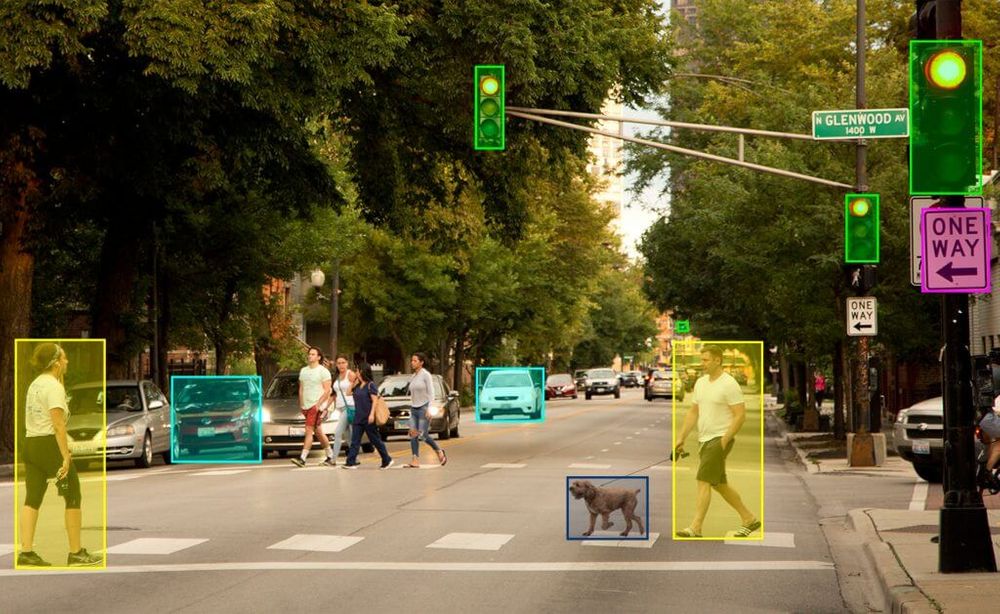
TagX offers to get the high-quality training data sets for AI cameras in security surveillance systems. Mainly using the bounding box image annotation to detect the various objects and recognize the suspicious actions, TagX can produce a huge quantity of training data sets for AI in security cameras and video surveillance in the cities, towns and societies for safe living.

Image and Video Annotation for logistics and shipping industry

The shipping & logistics industry has become much more dominant in recent years as a result of the use of Artificial Intelligence.There are several key uses of AI in the shipping and logistics industry.

Artificial intelligence refers to systems that can better imitate, automate, and reproduce human thought, as well as take data-driven actions, than humans can. In other words, AI and humans have certain abilities in common. Such abilities include the ability to interpret different types of data, comprehend various datasets, learn in a number of ways, and generate solutions.

Artificial systems that are able to mimic human thought need large amounts of data as input for every operation. AI-based systems can process text, image, video, and sound data in the same way that humans can.

 AI in the shipping industry can be utilized to enhance shipping routes. AI can determine the best course at the best speed. The power of data allows the shipping industry to forecast and optimize future performance and so much more.

Some of the outstanding benefits of AI in the shipping industry include but are not limited to, improved analytics for decision-making, automation, safety, route optimization, and increased efficiencies.

1. Advanced analytics – Advanced analytics are used to make valuable business insights from many data sources. This will help ensure your decisions are based on data-proven methods. 

2. Automated equipment – AI and automation play a role in the shipping industry. Machine learning capabilities will help in the analysis of historical data by considering such things as weather patterns or busy/slow shipping seasons. Automating processes can help identify problems before they happen. This allows time to make adjustments.

3. Safety and improved security – Accidents can be reduced using artificial intelligence. AI can also be used to detect threats and other malicious activities.

4. Route optimization – Route optimization would build optimization models to determine the most efficient route to take. With the help of AI, a prediction of the best path with minimum fuel consumption, and considering the weather can be calculated.

5. Performance forecasting – Performance forecasting could take the relationship between speed and power to predict changes in performance due to underwater fouling. You could use historical data to understand what is the rate of the degradation of the performance of the vessels. 

AI for logistics:

 Different touch points across a supply chain generate extensive data. Better Machine Learning algorithms can extract predictive insights in logistics that are critical to decision-making. Artificial Intelligence can aid decisions related to capacity planning, forecasting, and network optimization, thereby streamlining operations and enhancing overall supply chain performance. AI is finding extensive use in dynamic route optimization, managing delivery time windows, optimize fuel consumption, and load capacity utilization, among many other activities in last-mile deliveries thereby propelling the digitization of supply chains.

AI for Shipment Tracking: 

Shipment visibility data is of critical importance to overall supply chain performance. AI-powered tracking and tracing capabilities help accurate prediction of ETAs and ETDs. Furthermore, the ability to alert on supply chain disruptions, delays, and risks in shipping routes can help businesses increase agility and employ backup measures to avoid significant losses. Machine Learning can also help analyze historical data to identify shipping patterns considering various factors such as weather conditions, seasonal demand fluctuations, congestion in trade lanes, etc. With extensive use of voice-based assistants or chatbots, customers or customer service personnel can extract the tracking information in seconds.

Conclusion

The potential of artificial intelligence is hard to ignore. The number of successful case studies and examples will continue to grow as we look toward the future, for the integration of AI in the shipping industry. 

Artificial intelligence can deliver considerable benefits to the supply chain and shipping operations. Some advantages include reduced cost, less risk, improved forecasting, faster deliveries through more optimized routes, and more.

Digital change has its benefits for the port, supply chain, customer, and environment. The ability to move swiftly between various cargoes is also essential. Selecting the right coating extends the range of cargoes, reduces the time needed to switch them, and delivers the highest return on investment (ROI).

TagX Annotation Services

When building an AI model, you’ll start with a massive amount of unlabeled data. Labeling that data is an integral step in data preparation and preprocessing for building AI.The entire data labeling workflow often includes data annotation, tagging, classification, moderation, and processing. TagX helps you prepare the best training data for enhancing these models using various annotation techniques.

We provide you with high-quality training data by integrating our human-assisted approach with machine-learning assistance. Our text, image, audio, and video annotations will give you the courage to scale your AI and ML models. Regardless of your data annotation criteria, our  managed service team are ready to support you in both  deploying and maintaining your AI and ML projects. 

Application of Computer Vision in different Industries

Only in recent years did the world witness a significant leap in technology that has put computer vision on the priority list of many industries.

Computer vision technology is transforming the business world with its capability to understand the content of digital images and videos. It enables machines to precisely identify and classify images based on deep learning capabilities. Computer vision can be used across different industry verticals to enhance productivity, efficiency, customer experience, reduce operating costs, minimize defects, and improve security.

Application of computer vision technology is very versatile and can be adapted to many industries in very different ways. Some use cases happen behind the scenes, while others are more visible. Most likely, you have already used products or services enhanced by the innovation.

From our research, we’ve found that many of the use cases of computer vision fall into the following clusters:

Computer Vision in Automotive

 Computer vision systems in autonomous vehicles like self-driving cars continuously process visual data from road signs to seeing vehicles and pedestrians on the road and then determine what action to take. 

 Applications of computer vision in ADAS are prominent. Computer vision through vision based ADAS (Camera based), RADAR, and LIDAR technologies are paving the way for automotive companies towards fully automated self-driving cars. Different systems inside a car perform different tasks like camera based ADAS provides visual representation, Radar works in case of low visibility, and LIDAR provides 3D representation of vehicle’s surroundings with object recognition. However, all these applications of ADAS are possible with computer vision technologies, which together provides a holistic solution in ADAS applications. This allows the driver to have better awareness of his surroundings while driving, and at the same time have more control.

Computer Vision in Retail

Computer vision has made a squelch in the retail sector as well. Apart from ensuring security, spillage detection, and theft control, video analytics in retail with computer vision can help retailers concentrate on improving the customer’s shopping experience and optimizing operations.

Gourmet candy retailer Lolli & Pops uses computer vision based facial recognition to identify loyalty members as they walk into the store. By sifting through their purchasing history and preferences, the system can make personalized product recommendations specific to each shopper. Doing so, instills brand loyalty, and also converts occasional shoppers into regular customers. Amazon uses computer vision at Amazon Go stores, to allow customers to pay for goods without the need for a checkout.

Computer Vision in Manufacturing

Computer vision technologies in manufacturing units are very useful and they have unprecedented benefits to the business, like:

Predictive Maintenance: the role of computer vision comes into the picture, which analyzes every component of the production line and diagnose even the minute defects in the system. Based on the detailed and precise investigation, computer vision systems can predict any chances of future failure in the system, notifies technical team to fix that cause, and ensures no downtime in the production.

Identifying Defects: Inspection for the defects in the industrial setup can be very risky, tedious, costly and time consuming, and sometimes it is next to impossible to detect any defects in the machines manually. Computer vision technologies in such cases help in eliminating risks for the workers and works precisely to identify cracks, corrosion, leaks and other anomalies in the machines.

 Computer vision in Security and Surveillance

The security and surveillance industry was one of the first to implement computer vision technologies. It is computer vision that has greatly enhanced video surveillance and intelligent video analytics techniques and accuracy. The amount of data produced by video surveillance systems is calculated by the number, form, and resolution of video cameras used in a given project.The huge amount of video feeds are of no use, unless some critical information can be generated. Computer vision has made this possible with use of AI and ML in video analytics.

Computer vision capabilities in security and surveillance are based on video management software and its hardware, third party devices (like sensors, alarms, access control devices), network, interfaces, signal processing capabilities, pattern and object recognition, etc.

Computer vision in Healthcare

In healthcare, computer vision has the potential to bring in some real value. While computers won’t completely replace healthcare personnel, there is a good possibility to complement routine diagnostics that require a lot of time and expertise of human physicians but don’t contribute significantly to the final diagnosis. This way computers serve as a helping tool for the healthcare personnel.

One of the main challenges the healthcare system is experiencing is the amount of data that is being produced by patients. It’s estimated that healthcare related data is tripled every year. Today, we as patients rely on the knowledge bank of medical personnel to analyze all that data and produce a correct diagnosis. This can be difficult at times.

Microsoft’s project InnerEye is working on solving parts of that problem by developing a tool that uses AI to analyze three-dimensional radiological images. The technology potentially can make the process 40 times quicker and suggest the most effective treatments.

Computer vision in agriculture

 With the help of drones, farmers can spot crop diseases, predict crop yields, and, overall, automate the time-consuming processes on manual field inspection. It can also identify weeds so that herbicides can be sprayed directly on them instead of on the crops. During  CES 2019, John Deere featured a semi-autonomous combine harvester that uses artificial intelligence and computer vision to analyze grain quality as it gets harvested and to find the optimal route through the crops. Companies like Cainthus uses predictive imaging analysis to monitor the health and well-being of crops and livestock.

Computer vision applications provide valuable information about the irrigation management water balance. A vision-based system can process multi-spectral images taken by unmanned aerial vehicles (UAVs) and obtain the vegetation index (VI) to provide decision support for irrigation management.

Conclusion

It’s all about the usage of computer vision applications increased in various industries. Some of the industries have adopted the technology faster than others. How much may be computer vision technology increasing it continues to rely on the human effort to monitor, interpret, analyze, control, and decision-making. In addition to helping the automation, computer vision allow stores to operate with minimal human intervention.

As machines and humans continue to collaborate, the human workforce will be freed up to emphasis on higher-value errands because the tools will computerize the process that relies on image recognition.

Data Annotation for Aerial Imagery and Use Cases

Satellite imagery contains a tremendous amount of information.Annotating an image is the process of adding information to the image.Proper annotation of satellite imagery adds a great deal of value to the image by collecting, preserving and sharing knowledge about the scene. Added information can take many forms including labels for objects, tags describing the semantic content of the image, or segmented and labeled regions.

Many aerial imaging companies are trying to solve some of the hardest problems in the world in areas such as deforestation, agriculture, home insurance, construction, security, and others. In most of these applications, the objects from the satellite or drone imagery footage are far from having rectangular shapes. Instead of rectangular localization or counting the number of objects in the space (using bounding boxes), companies often need tools for calculating the exact pixels from the aerial image data.

Image annotation for satellite images is available for all types of techniques to detect or recognize the different types of objects from observed from the aerial view. Different types of image annotation techniques are used to annotate the different satellite images with right accuracy.

Aerial image annotation involves labeling satellite images or images taken by aircraft and UAVs. These images are then used to train computer vision models to analyze key features of a given environment.

  • Annotation for Agriculture imagery – In agriculture field image annotation helps to make crops and other things recognizable to make the right decision without use of humans. Annotating aerial images of farms will help users to find how much land is devoted to each crop, how healthy the plants are, and how quickly they are growing.
  • Annotation for shipping industry – Very high resolution satellite data is a core component of marine monitoring services, and provides a cost-effective method for monitoring large and remote areas. Data annotation of such critical data is important to achieve Identification of individual vessels And get  important details such as ship dimensions, orientation and location.
  • Annotation for Urban houses – Urban planning to make cities more livable, and sustainable. All types of images taken from the satellite or space heights can be annotated to recognize the man made structures like houses, huts and buildings for urban management and smart city layout and planning management.
  • Annotation for Construction sites – Inspections are now characterised by drones, especially in industries. We label people, objects and other field equipment in aerial images captured by drones using various annotation techniques.
  • Annotation for disaster management – Aerial images can be labeled according to their portrayal of roads, buildings, ports, and more. These images can be used to determine real-time road conditions and the extent to which certain structures are compromised, allowing first responders to navigate safely and act quickly.

TagX Annotation Services

We provide you with high-quality training data by integrating our human-assisted approach with machine-learning assistance. Our text, image, audio, and video annotations will give you the courage to scale your AI and ML models. Regardless of your data annotation criteria, our  managed service team are ready to support you in both  deploying and maintaining your AI and ML projects.

Types of Image Annotation for Artificial Intelligence and Machine Learning

For computer vision, there are many types of image annotations out there, and each of these annotation techniques has different applications.

With these different annotation methods, are you curious about what you can achieve? Let’s take a look at the various methods of annotation used for applications of computer vision, along with some special use cases for these particular forms of computer vision annotation.

Types of Annotations

We need to be familiar with the various image annotation approaches themselves before we delve into use cases for computer vision image annotation. Let’s review the most common techniques for image annotation.

1. Bounding Boxes

Bounding boxes are, due in part to their flexibility and simplicity, one of the most widely used forms of image annotation in all computer vision. Bounding boxes enclose objects and help localize objects of interest to the computer vision network. They are simple to construct by simply defining the X and Y coordinates for the box’s upper left and lower right corners.

2. Polygonal Segmentation

Polygonal segmentation is another form of image annotation, and the theory behind it is merely an extension of the theory behind bounding boxes. Polygonal segmentation informs a computer vision device where to search for an object, but the position and boundaries of the object can be defined with much greater precision due to the use of complex polygons and not simply a box.The benefit of using polygonal segmentation over bounding boxes is that it takes out a significant portion of the object’s noise/unnecessary pixels that can potentially confuse the classifier.

3. Line Annotation

The formation of lines and splines, which are mainly used to delineate boundaries between one part of an image and another, includes line annotation. Where a region that needs to be annotated may be thought of as a boundary, line annotation is used, but for a bounding box or another form of annotation, it is too small or thin to make sense.Splines and lines are simple to establish annotations for situations such as teaching warehouse robots to identify discrepancies between sections of a conveyor belt or to recognize lanes for autonomous vehicles and are widely used for them.

4. Landmark Annotation

For computer vision systems, the fourth form of image annotation is landmark annotation, often referred to as dot annotation, due to the fact that it requires the formation of dots/points throughout an image. To mark objects in images containing several small objects, only a few dots may be used, but it is usual for several dots to be joined together to represent an object’s outline or skeleton.The size of the dots can vary, and often larger dots are used to differentiate significant/landmark areas from surrounding areas.

5. 3D Cuboids

Similar to bounding boxes, 3D cuboids are a powerful type of image annotation in that they differentiate where objects should be searched for by a classifier. In addition to height and width, however, 3D cuboids do have depth.

Usually, anchor points are located at the edges of the piece, and a line fills up the space between the anchors. This provides a 3D representation of the object, meaning that in a 3D environment, the computer vision system can learn to discern features such as volume and location.

6. Segmentation Semantic

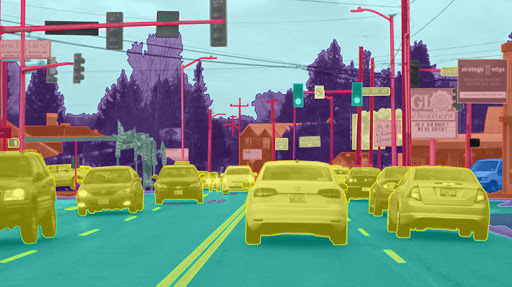
Semantic segmentation is a type of annotation of images that involves splitting an image into different regions, assigning each pixel in an image to a mark.

Separate from other regions, regions of a picture that bear different semantic meanings/definitions are considered. For instance, “sky” could be one portion of a picture, while “grass” could be another. The main idea is that regions are specified on the basis of semantic information and that every pixel comprising that region is given a label by the image classifier.

Use Cases For Image Annotation Types

1. Bounding Boxes

In computer vision image annotation, bounding boxes are used for the purpose of helping networks localize artifacts. Bordering boxes benefit from models that localize and identify items. Popular bounding box uses include any situation where objects are being tested against each other for collisions.

Autonomous driving is an obvious implementation of bounding boxes and object detection. Autonomous driving systems need to be capable of identifying vehicles on the road, but they may also be used to help assess site safety in circumstances such as marking objects on construction sites and to identify objects in various environments for robots.

Bounding box use cases include:

Using drone footage to monitor the progress of building projects, all the way from the initial laying of foundations to the completion when the house is ready to move in.

To automate aspects of the checkout process by identifying food goods and other items in grocery stores.

Detecting damage to outdoor vehicles, allowing for a thorough review of vehicles as claims for insurance are made.

2. Polygonal Segmentation

The method of annotating objects using several complex polygons is polygonal segmentation, allowing objects with irregular shapes to be captured. Polygonal segmentation is used over bounding boxes when precision is of value. Since polygons can catch an object’s outline, they minimize the noise inside a bounding box that can be found, something that can theoretically throw the model’s accuracy away.

In autonomous driving, polygonal segmentation is beneficial, where irregularly formed items such as logos and street signs can be highlighted and cars more precisely located compared to the use of bounding boxes to locate cars.

For tasks where several irregularly formed objects need to be correctly annotated, such as object detection in images captured by satellites and drones, polygonal segmentation is also useful. Polygonal segmentation should be used over bounding boxes if the purpose is to detect artifacts such as water features with accuracy.

In computer vision, notable use cases for polygonal segmentation include:

Annotation of the many artifacts found in cityscapes that are irregularly shaped, such as vehicles, trees, and pools.

Polygonal segmentation can also make artifacts easier to detect. For example, a polygon annotation tool, Polygon-RNN, sees substantial improvements in both speed and precision compared to the conventional methods used to annotate irregular shapes, namely semantic segmentation.

3. Line Annotation

Since line annotation is about drawing attention to lines in an image, it is best used if significant characteristics are linear in appearance.

A common case of use for line annotation is autonomous driving, as it is used to delineate lanes on the route. Similarly, line annotation may be used to direct industrial robots to position certain items between two lines, designating a target region. For these purposes, bounding boxes could potentially be used, but line annotation is a much cleaner option since it eliminates much of the noise that comes from bounding boxes being used.

Notable examples of line annotation for computer vision use include the automated identification of crop rows and even the monitoring of insect leg positions.

4. Landmark Annotation

Because landmark annotation/dot annotation draws small dots representing items, small objects are detected and quantified as one of its key uses. For example, the use of landmark detection to find objects of interest such as vehicles, buildings, trees, or ponds can be needed for aerial views of cities.

Having said that, landmark annotation may also have other applications. Combining several landmarks together, like a connect-the-dots puzzle, will produce outlines of objects. It is possible to use these dot outlines to identify facial features or to examine people’s motion and stance.

Some computer vision use instances for annotation of landmarks are:

Thanks to the fact that tracking several landmarks will make it easier to identify feelings and other facial features, Face Recognition.

Landmark annotation is also used for geometric morphometrics in the field of biology.

5. 3D Cuboids

When a computer vision system not only has to identify an object, 3D cuboids are used, it must also predict the general shape and volume of that object. When a computer vision system is designed for an autonomous system capable of locomotion, 3D cuboids are more often used, since they need to make assumptions about objects in their surrounding world.

The use of 3D cuboids in computer vision involves the development of autonomous vehicle computer vision systems and locomotive robots.

6. Semantic Segmentation

A potentially unintuitive fact about semantic segmentation is that it is essentially a classification form, but rather than an entity, the classification is only performed on every pixel in the desired area. When this is considered, it becomes easy to use semantic segmentation for any role where it is appropriate to classify/recognize sizeable, distinct regions.

One application of semantic segmentation is autonomous driving, where the AI of the car must differentiate between road sections and grass or sidewalk sections.

For semantic segmentation, outside of autonomous driving, additional computer vision use cases include:

To detect weeds and particular types of crops, the study of crop fields.

Medical image recognition for diagnosis, identification of cells, and measurement of blood flow.

To strengthen conservation efforts, monitoring forests and jungles for deforestation and biodiversity disruption.

Conclusion

It is only a matter of choosing the right resources for the job that almost anything you want to do with computer vision can be accomplished. The best thing to do now that you have become more familiar with the different forms of image annotation and potential use cases for them is to conduct an experiment to see which annotation strategies function best with your application.

You can also book a free consultation with TagX to consider the right annotation for your project.

What is Data Annotation and types of Annotations?

Artificial intelligence (AI) can only be as strong as the data it is fed. Given that the quality and quantity of training data are directly related to the performance of an AI algorithm.

Huge volumes of data are not rare nowadays. However, if you want to use it to train machine learning and deep learning models, you’ll have to enrich the data before you can use it for deployment, testing, and tuning. Large quantities of carefully labeled data are needed to train machine learning and deep learning models. Labeling and preparing raw data for use in machine learning models and other AI jobs is known as data labeling or data annotation.

Whether we’re talking about product recommendations and search engine results, or self-driving cars and autonomous drones, high-quality, human-powered data annotation helps build and improve machine learning applications across industries.

Data Annotation or labeling

Data labeling and annotation are the words used interchangeably to represent the art of tagging or label the contents available in various formats.

The data available in various formats are labeled with specific techniques to make it comprehensible to machines that can understand and analyze the information to give the results accordingly.

Labels are used by the human-in-the-loop to classify and make reference to features in the data. If you want to create high-performing algorithms in pattern recognition, classification, and regression, you must choose descriptive, discriminating, and independent features to label. Ground truth can be given by correctly labeled data while testing and iterating the models.

These are the features that you want your machine learning system to recognize on its own, with real-world data that hasn’t been annotated.

Types of Data Annotation

Bounding boxes

The image is enclosed in a rectangular box, defined by x and y axes. The x and y coordinates that define the image are located on the top right and bottom left of the object. Bounding boxes are versatile and simple and help the computer locate the item of interest without too much effort. They can be used in many scenarios because of their unmatched ability in enhancing the quality of the images.

Lines and splines

lines are used to delineate boundaries between objects within the image under analysis. Lines and splines are commonly used where the item is a boundary and is too narrow to be annotated using boxes or other annotation techniques.

Semantic segmentation

Image segmentation is a more sophisticated type of data labeling. It means dividing our image into various parts, called segments. By dividing the image into segments, we can gain a far deeper understanding of what is happening in the image and how various objects are related.

3D cuboids

Cuboids are similar to the bounding boxes but with additional z-axis. This added dimension increases the detail of the object, to allow the factoring in of parameters such as volume. This type of annotation is used in self-driving cars, to tell the distance between objects.

Polygonal segmentation

a variation of the bounding box technique. By using complex shapes (polygons) and not only the right angles of bounding boxes, the target object’s location, and boundaries are defined more accurately. Increased accuracy cuts out irrelevant pixels that can confuse the classifier. This is good for more irregular-shaped objects – cars, people, and logos, animals.

Landmark and key-point

This involves the creation of dots around images such as faces. It is used when the object has many different features, but the dots are usually connected to form a sort of outline for accurate detection.

Natural language processing services

Named Entity Recognition

We identify entities in a paragraph like a person, company name, location or time or any other category as per requirement.

Part-of-speech tagging

Each part of a sentence is tagged as nouns, verbs, adjectives, adverbs, and other descriptors.

Sentiment analysis

We can categorize the impact of a text or audio as positive, negative, or neutral or judging of a customer and other similar tasks

Document classification

We assign tags/categories to text or documents according to the content. Text classifiers can be used to structure, organize, and categorize any text.

Text Transcription

Our experts can transcribe audio and text, like text data can be converted to audio data for your assistant.

TagX Annotation Services

TagX offers high-quality training data by integrating our human-assisted approach with machine-learning assistance.

Our text, image, audio, and video annotations will give you the power to scale your AI and ML models. Regardless of your data annotation criteria, our managed service team is ready to support you in both deploying and maintaining your AI and ML projects.

Schedule a call today.

The Best 50 Free Datasets for Machine Learning

TagX has collected a list of data sources for Machine Learning (ML) and Natural Language Processing (NLP). In our previous articles, we explained why datasets are such a crucial part of Machine Learning (ML) and Natural Language Processing (NLP). Without these training datasets, machine-learning algorithms would have no way of learning how to do textual mining, textual content classification or categorize products.

This article is one of the best lists of open datasets for Machine learning. They vary from the large(looking at you, Kaggle) to the relatively specific, such as finance or Amazon product datasets.

First, when searching for datasets, some short pointers to keep in mind:

  • Look for clean datasets because you don’t want to spend time on your own cleaning up the info.
  • Look for datasets, since those are easier to deal with, without too many rows and columns.
  • An interesting query should be posed that can be answered using the dataset.

Sea of Open Dataset

Where can I download free, open machine learning datasets?

Practicing with multiple tasks is the perfect way to practice machine learning. Using these big dataset finders, you can search and download free datasets online.

Kaggle: A data science platform that features a number of interesting datasets that are externally contributed. In its master list, you can find all sorts of niche datasets, from ramen scores to basketball data to even Seattle pet licenses.

UCI Machine Learning Repository: One of the web’s oldest dataset sources, and a perfect first stop when searching for interesting datasets. Although the data sets are user-contributed and may have varying cleanliness levels, the vast majority are clean. You can download data directly, without registration, from the UCI Machine Learning repository.

Government Datasets for Machine Learning

Where can I download Machine Learning Public Government Datasets?

By acting as the base for major economic decisions, demographic data is an important instrument for transforming government and society. Trained machine learning models using public government data will assist policymakers to identify patterns and plan for problems related to population decline or development, aging, and migration.

Data.gov: This platform allows data from various US government departments to be accessed. Data can vary from government budgets to performance scores for schools. However, be warned: much of the knowledge needs additional analysis.

EU Open Data Portal: The EU Open Data Portal offers access to open data released by EU institutions in areas as varied as finance, jobs, research, and the climate.

School System Finance: This dataset was created by means of a survey of the US school system’s finances.

US Healthcare Info: The FDA drug database and USDA Food composition database in this dataset have collected data on population health, illnesses, medications, and health plans.

The U.S. National Center for Education Statistics: This site hosts data from the U.S. and around the world on educational institutions and education demographics.

The UK Data Service: Here you can find the largest collection of social, economic and population data from the UK.

Data USA: A detailed visualization of US public data is available on this platform.

Machine Learning Datasets for Finance & Economics

Where can I download datasets for finance and economics for machine learning?

For the financial sector, machine learning is proving a golden opportunity. Quantitative financial records have been held for decades, so the industry is ideally suited to machine learning. Indeed, for algorithmic trading, stock market forecasts, and fraud detection, machine learning is already changing finance and investment banking.

Quandl: A good source of economic and financial data, useful for the prediction of economic indicators or stock prices for building models.

Accessible Data from the World Bank: databases covering population demographics and a large range of global economic and development indicators.

IMF statistics: Data on international finances, debt rates, foreign exchange reserves, commodity prices, and investments are published by the International Monetary Fund.

Financial Times Market Data: Up-to-date statistics, including stock price indices, commodities, and foreign exchange, on financial markets from around the world.

Google Trends: Investigate and evaluate internet search activity details and pattern trends.

American Economic Association (AEA): A good source to find US macroeconomic data.

Datasets for Computer Vision

Where can I download Computer Vision Image Datasets?

Picture datasets, such as medical imaging technology, autonomous vehicles, and facial recognition, are helpful for training a wide variety of computer vision applications.

Labelme: A large annotated image dataset.

ImageNet: For modern algorithms, the de-facto image dataset. It is structured according to the hierarchy of WordNet, in which hundreds and thousands of images are represented by each node of the hierarchy.

LSUN: With several ancillary activities, scene comprehension (room layout estimation, saliency prediction, etc.)

MS COCO: Generic comprehension and captioning of pictures.

COIL100: 100 different 360-rotation objects pictured at every angle.

Visual Genome: Visual knowledge base with very detailed captioning of ~100K images.

Google’s Free Images: A set of 9 million image URLs that have been annotated under Creative Commons with labels covering over 6,000 categories.

Dataset for Stanford Dogs: Includes 20,580 photos and 120 distinct types of dog breeds.

Indoor Scene Recognition: A very particular dataset, useful because ‘outside’ is easier for most scene recognition models. It includes 67 indoor categories and a total of 15620 pictures.

VisualQA: There are open-ended questions related to 265,016 photos in this dataset. The questions posed involve knowledge of vision and language to respond.

Sentiment Analysis Datasets for Machine Learning

Where can I download datasets for machine learning with sentiment analysis?

To learn effectively, sentiment analysis models require massive, specialized datasets. Any of the endless ways that you can enhance your sentiment analysis algorithm should be suggested in the following list.

Dataset Multidomain Sentiment Analysis: A slightly older dataset that includes Amazon product reviews.

IMDB Ratings: Featuring 25,000 movie reviews, an older, comparatively limited dataset for binary sentiment classification.

Standard sentiment Treebank: Stanford Sentiment Treebank.

Sentiment140: A common dataset that uses 160,000 tweets with pre-removed emoticons.

Twitter US Airline Sentiment: February 2015 data from Twitter on US airlines, categorized as optimistic, negative, and neutral tweets.

Datasets on Natural Language Processing

Where can I download open natural language processing datasets?

Enron Dataset: Email info, organized into directories, from the senior management of Enron.

Amazon Reviews: Includes nearly 35 million Amazon reviews spanning 18 years. Data includes product and user data, reviews, and analysis of plaintext.

Ngrams Google Books: A list of Google book words.

Blogger Corpus: A 681,288 series of blog posts compiled from blogger.com. There are a minimum of 200 occurrences of widely used English words in each blog.

Wikipedia Links Data: Wikipedia’s full text. Nearly 1.9 billion words from more than 4 million papers are in the dataset. You can scan for a paragraph by title, phrase or part of it itself.

Gutenberg eBooks List: Project Gutenberg’s annotated list of ebooks.

Hansards Text Chunks from the Canadian Parliament: 1.3 million texts in pairs from the 36th Parliament’s documents.

Jeopardy: Archive of over 200,000 questions from the Jeopardy quiz show.

SMS Spam Compilation in English: A dataset consisting of 5,574 SMS spam messages in English.

Yelp Reviews: More than 5 million reviews are included in an open dataset published by Yelp.

UCI’s Spambase: A major dataset of spam addresses, useful for filtering spam.

Datasets for Autonomous Vehicles

Where do I download open datasets for autonomous vehicle training?

Autonomous vehicles need to be trained with vast volumes of high-quality datasets so that their environment and surrounding objects can be viewed accurately.

Berkeley DeepDrive BDD100k: The largest self-driving AI dataset at present. Contains more than 100,000 views of driving journeys of over 1,100 hours through various periods of the day and weather conditions. The annotated pictures are from the regions of New York and San Francisco.

Baidu Apolloscapes: Broad dataset of images defining 26 distinct semantic objects such as vehicles, motorcycles, pedestrians, homes, street lights, etc.

Comma.ai: More than 7 hours of traveling on highways. Car speed, acceleration, steering angle, and GPS coordinates are included in the data.

Oxford’s Robotic Car: Taken over a span of one year, over 100 repetitions of the same path via Oxford, UK. Along with long-term improvements such as construction and roadworks, the dataset records various combinations of weather, traffic and pedestrians.

Cityscape Dataset: A broad dataset of 50 different cities that tracks urban street scenes.

KUL Belgium Traffic Sign Dataset: More than 10000+ traffic sign annotations in the area of Flanders in Belgium from thousands of physically distinct traffic signs.

MIT AGE Lab: A sample of the 1,000+ hours obtained at AgeLab of multi-sensor driving datasets.

LISA: This dataset contains traffic signals, vehicle identification, traffic lights, and trajectory patterns. LISA: Laboratory for Intelligent & Secure Cars, UC San Diego.

Are you still struggling to find what you need? TagX has been developing extensive, reliable datasets for machine learning projects. We are well placed to create the custom dataset you have been looking for with highly trained linguists working across languages.


How Artificial Intelligence and Machine Learning Can Help In Agriculture

Artificial Intelligence is growing at a rapid pace. With advances in computational capabilities and increased cloud penetration, wider parts of the world economies have started to reap the benefits of Artificial Intelligence. (Machine Learning)

Agriculture is a field that has started to leverage AI for its benefits. Be it containing weeds, calculating the best time to harvest crops, Monitoring the health of soil and crops, or predicting the yield in advance.

Be it small farmers or Large corporations having a vast amount of land AI has something to offer to everyone.

Pests have always plagued farmers. Some ten thousand years after the invention of agriculture, locusts, grasshoppers, and other crop devouring insects still eat profits and gobble grains that would otherwise feed human beings. But AI gives growers a weapon against cereal-hungry bugs.

Not long ago, a farmer in Texas checked the direction of the wind and reckoned a swarm of grasshoppers was likely to descend on the southwest corner of his farm. But before he could check his crops, the farmer got an alert on his smartphone from the AI and data company he hires to help monitor his farm.

Checking new satellite images against pictures of the same parcel over a five-year period, an AI algorithm detected that the insects had landed in another corner of the farmer’s field. The farmer inspected the section, confirmed the warning was accurate, and removed the costly pests from his field of nearly ripened corn.

Artificial intelligence holds the promise of driving an agricultural revolution at a time when the world must produce more food using fewer resources. The future of agriculture and humanity is in safe hands with Artificial Intelligence.

TagX helps companies developing Artificial Intelligence solutions for Agriculture in Labeling their data collected from sensors, drones, and vehicles. TagX can segment machinery, crops, and humans in drone imagery, Tag sensor data or create synthetic datasets for testing sensors and also create solutions to monitor prices of different crops in real-time.

Drop us an email at sales@tagx.in to know more about our services.

Modern Machinery and AI: Data Labeling in Manufacturing

In the same way as other different ventures, producing has had new difficulties emerging with rise of globalization and digitalization of organizations. Speeding up creation, income instability, need for amplifying proficiency, and requirements for the versatility of creation to the market changes are among significant difficulties confronting producing today. Man-made intelligence has been there to help organizations settle these issues, accordingly, boosting producing measures in numerous enterprises with weighty resources. To be specific, AI in assembling is being conveyed in upkeep, quality checks, plan, coordinations. Computer-based intelligence is broadly utilized for its creation improvement through decrease of expenses and accuracy in counts and amassing, while “imaginative” ML calculations have been growing the limits of configuration by presenting exceptional upgraded structures and ways to deal with regular items and complex machines.

Predictive maintenance

The motivation behind prescient support calculations is to forestall exorbitant disappointment of apparatus and gear yet in addition to evading loss of creation. Calculations of condition observing and prognostics are utilized to sort and dissect data given by machine’s cycles and inward sensors. By gathering a lot of information identified with past glitches and machine disappointments and by persistently gathering increasingly more information, a calculation analyze deficiencies, gauges when the machine needs administration and alarms engineers.

Computerized twins

Making a virtual imitation of a machine or resource is a device for speaking to a current working cycle of an actual machine, with an extra capacity to foresee its condition later on through reenactment. Computerized twins can be actualized for the whole office or for explicit offices, measures, machines as it were.

AI Quality Control

Using image-based and sensor-based processes, AI can be just as good as (or even better than) a human QA specialist when it comes to large-scale production. Its benefit is in the ability to recognize even very small objects (for instance, tiny screws), missing components in machines during the production process or differentiate and sort objects very fast. Even such relatively simple tasks require a lengthy development process and plenty of labeled data in order to work properly.

Outsourcing Data Labeling

When discussing huge assembling cycles, the dangers and results of helpless AI are too high to possibly be dismissed. More often than not, the mistakes aren’t in the product itself, yet in the kinds of information utilized for its preparation, which characterizes how great machines are in acquiring a significant level of comprehension from genuine conditions. Top-notch information marking in a safe naming climate is the way to improve fabricating mechanization yet additionally facilitate the designer’s work of programming advancement. For organizations, AI-upheld fabricating arrangements could mean increment of organization benefits, which conceivably could be utilized to grow more inventive cycles, put into certain promising offices, or used to build the item generally quality. For shoppers, robotization might actually bring about expanded item moderateness.

Why to outsource Data Labeling Services

Data Collection and labeling are the core of any Machine learning model. These self-learning models require plenty of annotated information to train before they go live. So for many companies and researchers looking to develop AI or machine learning algorithms, there’s a choice that they have to make:- Do they have to outsource or do in-house labeling.

There are different aspects they need to consider before making the right choice. Focusing on security issues, one may go with in-house labeling. But Quality and cost are the other sides of the coin. In reality, there are benefits and hidden pitfalls in both of these approaches. Choosing the right one is a strategic decision, which may affect the overall developing process.

In the beginning, your labeling project might involve lots of subjective judgment elements and complex scenes. At this point, it is better to keep the annotation in the house to keep it agile. As your labeling requirements become clearer and data volume increases, you should consider adding outsourced services to increase the capacity of your labeling operation.

Benefits of outsourcing

Outsourcing Data labeling services allow your company to work with experienced and specialized annotators

  • The advantage of outsourcing your data annotation project is that professional annotators will deliver the highest level of data quality necessary to rapidly progress your project. In this way, you can focus on your project while we take care of your data.
  • It’s reasonable to outsource your data annotation to a professional team that is well-equipped to tackle high volumes of data and have them deliver high-quality datasets faster without compromising on accuracy.
  • Annotation companies are well aware that the security of data is essential and have data confidentiality agreements. At TagX we are particularly sensitive to our clients’ privacy concerns.

Therefore companies should carefully consider four aspects of data annotations before turning to internal resources for their data annotation needs. Concluding, outsourcing labeling needs is the ultimate time and resource saver.

Additionally, when doing business with the labeling partner, parties must establish an agreement that provides the specifics for labeling. Among the points required to include are subject-matter, the purpose of processing, the time frame during which the data may be processed, type, and categories of personal data, obligations, and rights.

We at TagX are committed to quality and follow standards that our clients request us to follow.

Visit us today at http://www.tagxdata.com

Design a site like this with WordPress.com
Get started