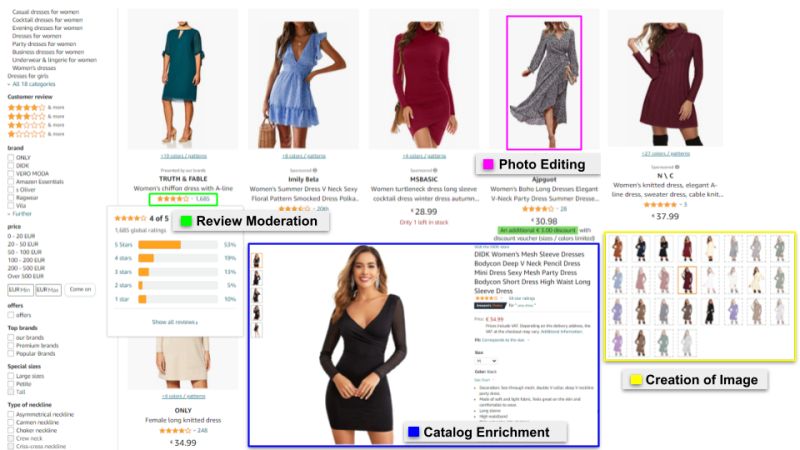
The importance of e-commerce product catalog management cannot be overstated, as it contains every last data about products and inventory. It contains up-to-date product information, such as product specifications, prices, marketing text, and digital assets, among other things. This allows visitors to the website to gain a complete understanding of products and make them accessible, which helps firms stand out from their competitors. As a result, the necessity of product catalog management for the company grows. Merchants will invest in a business if you have a well-maintained catalog. Catalog management has been shown to be a clever means of easing workflow because it is a simple solution for reducing the complexities of corporate processes.
Customers, both B2C and B2B, are used to looking for product information and shopping online these days. As a result, in order to fulfill these client habits, ensure that products are found and available online, and stay competitive, the company needs a well-managed online product catalog. A well-organized and informative e-commerce catalog will also help you establish yourself as an industry leader and foster trust among website users.

What is eCommerce Catalog Management?
eCommerce catalog management is a dynamic process in which products are categorized in a specified way to maintain high-quality data consistency across sales channels.
Catalog management is an important part of establishing an online brand since it allows customers to locate exactly what they’re looking for and feel confident in making a purchase based on the information supplied.
It assists retailers in managing product catalogs for different consumers and tracking inventory across many channels for eCommerce logistics.
Product names, descriptions, hierarchy, price, source, and other associated information can all be found in an online catalog. Color, style, pattern, neckline, sleeve, length, and fit are all granular features that must be exact within those categories in order for shoppers to be led to the correct product.
Challenges for E-commerce Product Catalog Management
Stakeholder Management
The involvement of stakeholders is critical for the success of a firm. This makes managing and updating product catalogs difficult and time-consuming. For example, if the units of measurement used by suppliers and systems mismatch, frequent manual adjustments are required.
Selecting the Most Appropriate Catalog Management Software
This necessitates a thorough awareness of both the tooling options’ functions and the company’s environment. If internal operating systems such as ERP, PIM, marketing, or e-commerce platforms differ across the globe, finding a scalable catalog management solution can be even more difficult.
Business and Catalogue Growth
The expansion of e-commerce product catalog management is directly related to the growth of the business. Always keep in mind that the company’s product catalog needs to be expanded as it grows. Any discrepancy in catalog structure, such as incorrect product assortment, can result in unanticipated issues during catalog expansion.
Scalability of the Catalog
Ecommerce product collection will expand as business operations expand across multiple locations. Companies must maintain consistency in their catalog structure as their businesses expand. Problems throughout the entire process of managing the product catalog can arise because of a lack of uniformity.
How to Improve eCommerce Product Catalog Management
The quality and consistency of data are impacted by many of the previous challenges we discussed. When customizing data for different sales channels, normalizing data from suppliers, or trying to extend the catalog with new products, maintaining high-quality data can be difficult.
The capacity to maintain data quality is usually determined by how you manage all of the data in one location. To keep track of their inventory, many retailers use Excel or their eCommerce platform. If you have a huge or complex online product catalog, though, these methods likely fall short.
It might be difficult to develop and maintain a consistent standard when managing huge amounts of SKUs in Excel or eCommerce platforms. Misspellings, omitted properties, and incorrect descriptions can all be found in item data.
Excel was not designed to manage eCommerce catalogs. You won’t have all of the tools you’ll need to keep product data up to date. To make mass updates and adjustments, you’ll only have the personnel to rely on, which can easily lead to human mistakes.
An ecommerce platform can manage basic SKUs, but it isn’t designed to manage catalogs. It won’t have more advanced features for importing, processing and publishing data to other sales channels. Additionally, eCommerce solutions do not assist in the integration of product data with advanced inventory management or order fulfillment requirements.
Best Practices for eCommerce Product Catalog Management
Provide relevant information
It should be your goal as an e-commerce business owner to provide accurate product information to your customers. This not only makes it easier for customers to navigate the web store, but it also increases their trust in your services. As a result, it’s critical to provide comprehensive, up-to-date, and accurate information about your products. On the market, there are several catalog management companies that can assist you with your product catalog. You can also include relevant images for your products.
Categorization of products
Another great way to create a well-organized product catalog is to group all of your products into different categories based on their specifications. It also improves your customers’ overall experience while browsing your e-store. Ecommerce product catalog management entails making sure that all product tags, such as size, color, and so on, are mentioned correctly. In addition, you should include some additional, but relevant, specifications in your product description.
The difference between online and offline catalogs
As we all know, the amount of information included in an online and offline catalog differs significantly. An offline catalog typically contains a lot of extra information, whereas an online catalog only provides the user with precise information, which should be worth the catch. If you’re unsure about the difference between the two, it’s best to seek professional catalog management services for your company.
Personalize your product catalog
It is important to keep in mind that your product catalog for B2C has to be different from the one for B2B purposes. This includes pricing, quantities, and various other factors. Hence, personalization during catalog management is crucial. It provides you with custom-made solutions for your business.
Use up-selling techniques
It’s critical to remember that your B2C product catalog must be distinct from your B2B product catalog. Pricing, quantities, and a variety of other factors are all considered. As a result, personalization is critical during catalog management. It provides you with tailor-made business solutions.
Final Thoughts
E-commerce product catalog management is critical for any online business, but it can be stressful at times due to the numerous issues that might occur due to vendor, stakeholder, and customer requirements. Product catalogs are a great method to keep ahead of the competition because they display precise information about products. It’s a great technique to get more customers to visit a website because you’ll have a strong handle on the seller and the customer’s wants. You may successfully run an e-commerce firm while providing useful information to clients by using the above-mentioned challenges and its solution as an e-commerce product catalog.
 Latest Updates